The History of Floral Clocks: How Flowers Became Nature's Timekeepers
October 05, 2026 by Jenny Thayer
What if you could tell time without a watch, phone, or clock?
Look to the garden.
Long before atomic clocks and computer networks synchronized time around the world, people looked to the natural world. The sun's movement, the changing length of shadows, and the opening and closing of flowers all provide clues about where we are in the day.
In the 18th century, Swedish botanist Carl Linnaeus took this idea a step further with his concept of the floral clock, the Horologium Florae. Instead of gears and hands, this clock relied on flowers opening and closing at different times of day.
What Is a Floral Clock?
A floral clock is a sequence of plants arranged according to the approximate times their flowers open or close. The concept is based on a simple observation: different plant species have different daily rhythms. Some flowers open in the early morning, while others don’t open until later in the day. Some close in the afternoon or evening.
Linnaeus realized that these natural rhythms could potentially be arranged into a sequence that provided an indication of the time. In his 1751 work Philosophia Botanica, he listed dozens of flowering plants and arranged them according to their observed opening and closing times. The result was essentially a clock powered by biology instead of machinery.
Linnaeus Didn’t Just Watch Flowers—He Watched Patterns
The floral clock wasn’t about finding one magical flower that opened at exactly noon. While working at Uppsala University, Linnaeus spent years observing how plants changed throughout the day and across the seasons. His Philosophia Botanica included 46 examples of flowering plants associated with particular portions of the day. Arranging 43 of those plants into a time sequence was an ingenious way of turning recurring patterns in nature into a way of understanding time.
How Accurate Was a Flower Clock?
While a floral clock sounds wonderfully precise, nature doesn’t operate like a mechanical clock.
Linnaeus distinguished between plants whose flowering times were more predictable and those whose opening and closing could change based on factors such as weather or the length of the day.
Location is another challenge. Many of the plants Linnaeus observed were native to Sweden, and flowering behavior can vary with latitude, season, weather, and other environmental conditions. That meant a floral clock based on Linnaeus' observations wouldn’t necessarily work the same way somewhere else.
Flower closure can also be influenced by pollination. Research published in Ecology Letters found that some flowers close earlier after being pollinated.
While a floral clock could only provide an approximate sense of time, that limitation is part of what makes it fascinating.
Did Linnaeus Actually Build a Floral Clock?
Although Linnaeus developed and documented the concept, the Linnaeus Garden at Uppsala University notes that he did not actually plant the complete floral clock he described.
During the 19th century, botanical gardens experimented with floral clocks, although creating a reliable one proved difficult.
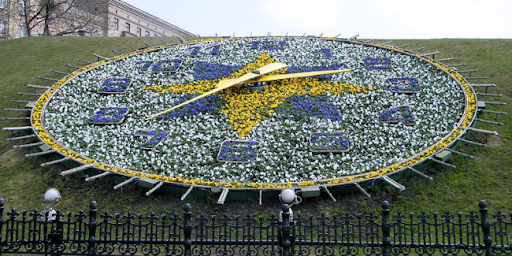
Eventually, the idea of the floral clock evolved into something more decorative. Rather than using flowers as the mechanism, designers began incorporating traditional clock mechanisms into large circular flower displays. The floral clock became a popular feature of parks, gardens, tourist attractions, and exhibitions.
From Flowers to Atomic Clocks
The floral clock may seem worlds away from the highly precise clocks that keep modern infrastructure synchronized. Yet both are built around the same fundamental idea: find something that changes in a predictable way and use that change to measure time.
For Linnaeus, that predictable phenomenon was the daily rhythm of plants.
Over the centuries, humanity found increasingly precise ways to measure time: flowers → shadows → water → pendulums → quartz → atomic transitions → network synchronization. Each step gave us a more reliable reference for understanding when something happened.
Eventually, knowing the time wasn’t enough. We needed systems to agree on the time.
From Measuring Time to Sharing Time
Today, computers, servers, financial systems, telecommunications networks, satellites, and countless other technologies rely on synchronized clocks.
A timestamp can tell a system when an event occurred. Synchronized time allows different systems to compare those events and establish a shared sequence.
That’s a significant evolution from the floral clock. A flower opening might tell one person that morning has arrived. A synchronized network can allow thousands of machines in different locations to agree on when an event occurred.
The technology has changed dramatically, but the underlying challenge remains remarkably familiar: how do we create a reliable reference for time?
Key Takeaways
- Timekeeping starts with observation.
- The floral clock demonstrates that timekeeping doesn’t necessarily begin with gears or electronics, but with noticing a predictable pattern in the world around us.
- A time reference is only useful when you understand its limitations.
- Flowers respond to environmental conditions. Modern clocks and synchronization systems have their own sources of uncertainty. Reliable timekeeping requires understanding and managing those variables.
- Accuracy becomes more important as systems become more connected.
- A person checking whether a flower has opened doesn’t need nanosecond precision. A globally distributed digital system may.
- The goal has evolved from knowing the time to agreeing on the time.
- Modern infrastructure doesn’t just need clocks. It needs clocks that can be synchronized and trusted across systems.
What’s Next in Clocks Through Time?
The floral clock is just one fascinating chapter in humanity’s long relationship with time.
From sundials and water clocks to astronomical clocks, pendulums, atomic clocks, and network time, every generation has developed new ways to measure, understand, and share time.
Network Time Foundation is exploring more of these fascinating clocks throughout history in our Clocks Through Time series.
Join the Conversation
What can a 300-year-old flower clock teach us about the technology keeping today’s world synchronized?
Join the discussion in the Network Time Foundation Discourse community to share your thoughts, discover more about timekeeping, and connect with others interested in the infrastructure behind accurate and reliable time.
Stay tuned for our next installment of Clocks Through Time.


