The History of Water Clocks: How Ancient Civilizations Measured Time
November 23, 2026 by Jenny Thayer
Before mechanical clocks and digital displays, people found ways to measure time using the natural world. The movement of the sun helped early civilizations track the hours, but what happened when the sun went down or the sky was overcast?
One answer was water.
Water clocks, also known as clepsydrae, used the steady flow of water to measure the passage of time. Developed thousands of years ago, these devices helped people organize daily activities, time speeches, conduct ceremonies, and observe the world around them.
What Is a Water Clock?
A water clock is a timekeeping device that measures time through the regulated flow of water into or out of a container. Unlike sundials, which rely on sunlight and shadows, water clocks could operate indoors, at night, and in conditions where the sun was unavailable.
The Greek word clepsydra comes from words meaning “to steal” and “water,” an appropriate name for a device that measures time as water slowly flows away.
When Were Water Clocks Invented?
Water clocks are among the oldest timekeeping devices in human history. Evidence of their use dates back thousands of years, with early examples appearing in ancient Egypt and Mesopotamia.
By the fifth century BCE, water clocks were also being used in ancient Greece. One well-known application was timing speeches in courts and public assemblies. A measured amount of water would flow from one vessel to another, giving speakers a set amount of time to make their case.
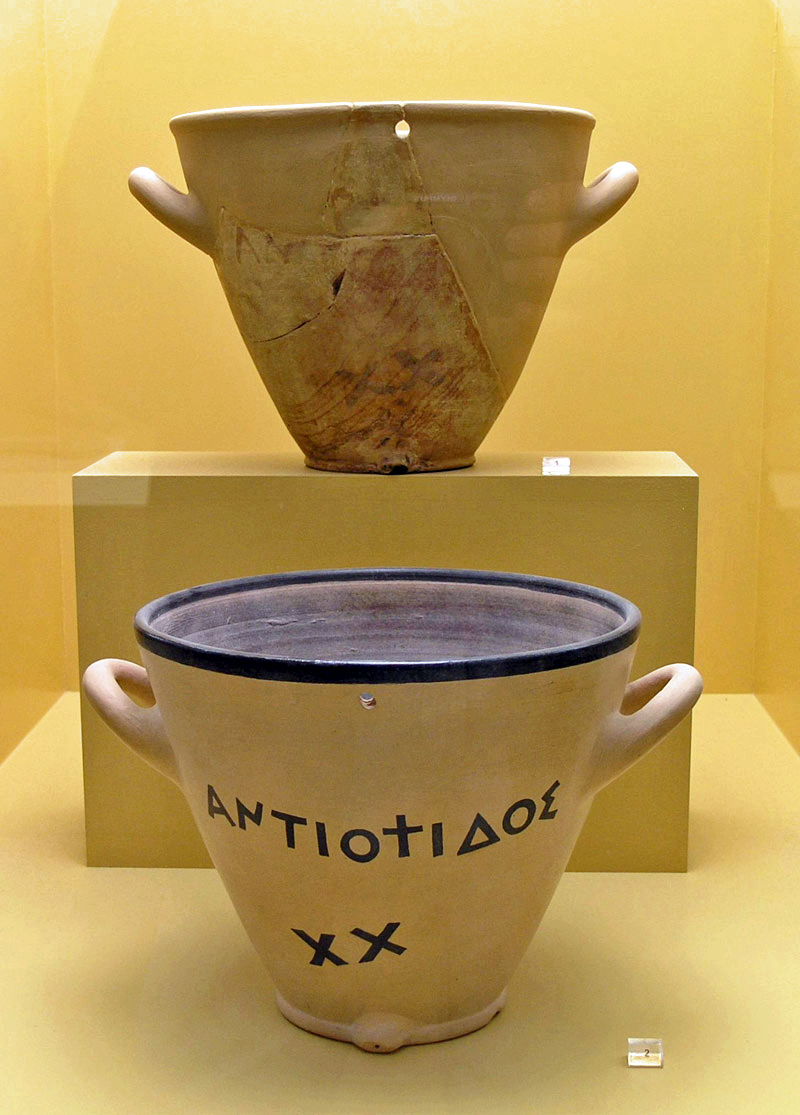
The figure helps illustrate how Greek water clocks developed: it shows an original late fifth-century BCE example alongside a reconstruction that gives us a clearer idea of how the device may have looked in use.
How Do Water Clocks Work?
The basic principle behind a water clock is simple: water moves at a measured rate, and that movement represents the passage of time.
There were two common designs:
- Outflow clocks: Water slowly drained from a container. Markings on the inside indicated how much time had passed as the water level dropped.
- Inflow clocks: Water entered a container at a controlled rate. As the water level rose, markings showed the elapsed time.
Some designs used carefully shaped openings to regulate the flow. Others incorporated floats, gears, or additional mechanisms to make time measurement more consistent.
Although their construction varied across civilizations, the underlying idea remained the same: use a predictable physical process to measure something that cannot be seen.
How Water Clocks Became More Advanced
As civilizations developed, water clocks became increasingly sophisticated.
In ancient Greece, they were used for practical timekeeping, particularly in legal proceedings and public speaking. In other parts of the world, engineers developed elaborate mechanisms that combined water flow with moving figures, bells, and astronomical displays.
One especially famous example is the elephant clock designed by the medieval engineer Al-Jazari. Its elaborate design combined water-powered mechanisms with figures and moving components to mark the passage of time.
These innovations show that water clocks were more than simple containers. They were early examples of engineering that translated a natural process into a mechanical system.
Why Water Clocks Weren’t Always Accurate
Water clocks were ingenious, but they had limitations.
Water does not always flow at a perfectly constant rate. Changes in water pressure, temperature, evaporation, and the shape of a vessel could affect how quickly water moved. Even small differences could make a clock gain or lose time.
Some designs also required regular attention. Water needed to be replenished, vessels cleaned, and mechanisms maintained.
These challenges meant that water clocks were useful timekeeping tools, but they were not always precise by modern standards.
From Water Clocks to Standardized Time
Water clocks represent an important step in humanity’s effort to measure and organize time.
They helped move timekeeping beyond simply observing the position of the sun. People could measure intervals, establish schedules, and coordinate activities using a device that operated independently of daylight.
Over centuries, new technologies introduced increasingly reliable ways to measure time, from mechanical clocks to quartz oscillators and atomic clocks.
Today, precise timekeeping supports systems that connect people and technology around the world. Network Time Protocol (NTP), for example, helps computers and connected devices synchronize their clocks with reliable time sources.
The technology has changed dramatically, but the underlying goal remains familiar: making sure time can be measured and shared consistently.
What Water Clocks Can Teach Us About Modern Timekeeping
Water clocks remind us that accurate timekeeping has always depended on more than simply having a clock. It requires reliable mechanisms, consistent measurements, and an understanding of the factors that can affect accuracy.
Modern network timekeeping faces its own challenges. Instead of water flow, today’s systems depend on communication networks, software, hardware, and trusted time sources.
The tools may be different, but the importance of dependable time has only grown.
From Flowing Water to Network Time
From ancient vessels tracking the flow of water to connected systems synchronizing clocks across the globe, humanity’s approach to timekeeping continues to evolve.
At Network Time Foundation, we’re focused on helping make accurate, reliable, and secure time available across the systems we depend on every day. Because whether time is measured by flowing water or synchronized across a network, getting it right matters.
Keep Exploring Clocks Through Time
Want to keep exploring the history of timekeeping? Join the conversation and share what you’ve learned about the technologies that helped shape how we measure time.


